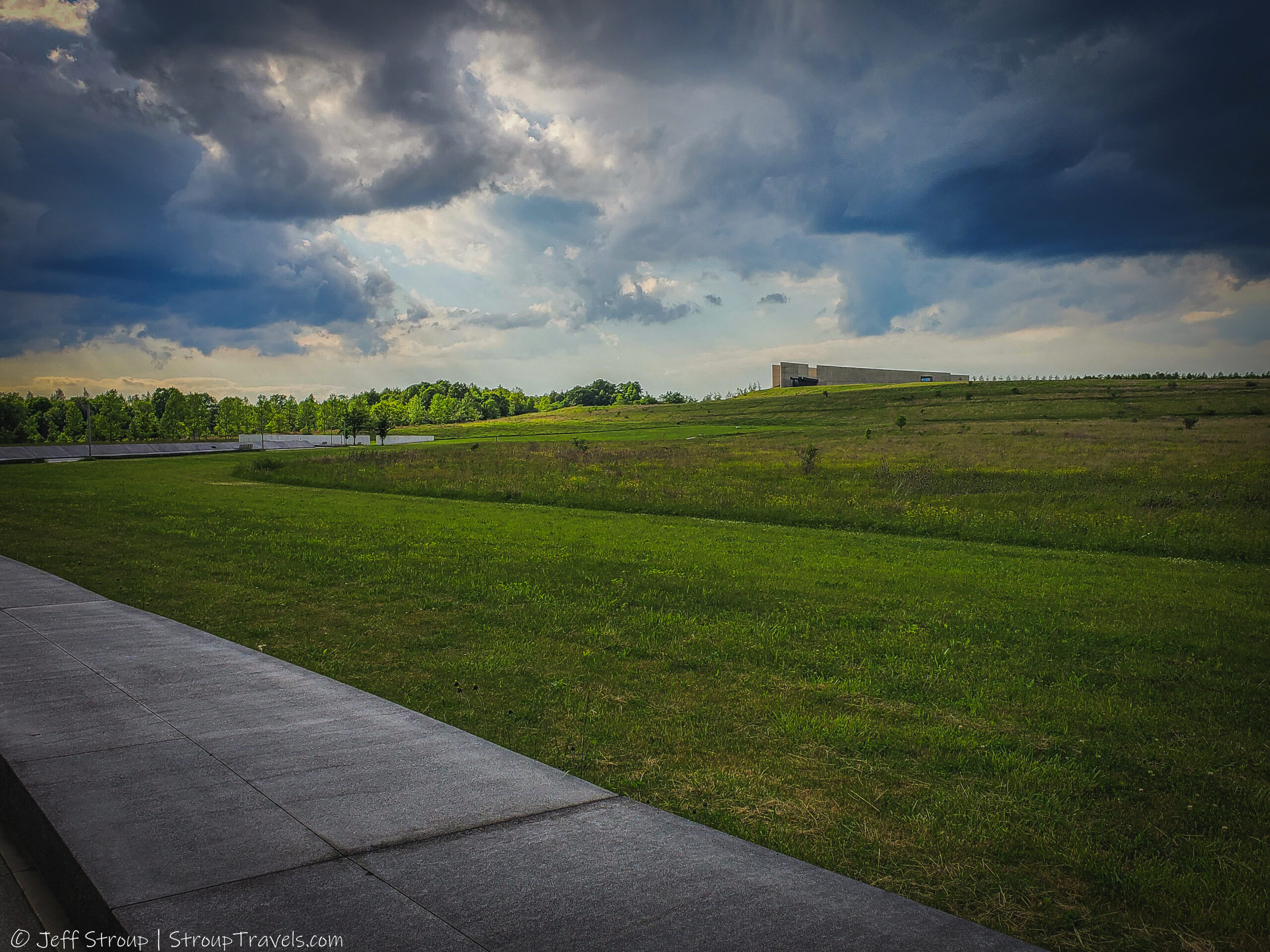
Flight 93 National Memorial is one of those places that’s hard to put into words until you’re actually standing there. It’s not like other historical sites. It’s not a battlefield from the 1800s where time has softened things. This is recent. Real. You remember where you were when it happened.
I was in 5th grade when September 11th unfolded.
And now you’re standing in the quiet countryside of Pennsylvania, just outside the small town of Shanksville, where one of those planes went down.
The feeling hits immediately. Sadness, respect, disbelief. It’s all mixed together in a way that doesn’t really settle.
What Happened Here
On September 11, 2001, United Airlines Flight 93 was hijacked as part of the coordinated terrorist attacks on the United States. But this flight didn’t reach its intended target.
Passengers and crew, aware of what had already happened in New York and Washington, made the decision to fight back. They attempted to retake control of the plane. They didn’t survive. But because of their actions, the plane never reached its target. It crashed here instead.
And that’s why this site exists.
First Impressions
The memorial is set in a quiet, rural area. You’re not driving through a city. You’re not surrounded by noise or traffic. Just open land and long stretches of road. Then you turn in.
A long entrance road leads you toward the main area, and it’s intentional. It gives you time to slow down, to separate from everything else before you arrive. Off to the side stands the Tower of Voices.
Tower of Voices
Tower of Voices rises 93 feet into the air, one foot for each passenger and crew member. Inside are 40 wind chimes. When the wind moves through them, you hear it. Not loud, not overwhelming, just a constant, subtle sound that carries across the landscape.
It’s one of the most unique parts of the memorial. There’s no speech. No explanation needed. Just sound. And it sticks with you.
Visitor Center Experience
The visitor center is one of the best-designed museum spaces you’ll come across. It’s modern, clean, and focused.
Inside, you’ll find artifacts recovered from the site, detailed timelines, and information about the passengers and crew. Everything is presented in a way that feels respectful and direct. And then there are the recordings. Passengers made phone calls before the crash. Messages left behind. Their final moments. You can listen to them. It is difficult, it’s eerie, and more importantly, it’s real.
This is where the memorial shifts from informational to emotional. You’re no longer reading history. You’re hearing it.
The Overlook
After moving through the visitor center, you step outside onto a walkway that leads to the overlook.
This is where it all comes together.
The design here is intentional in a way that’s hard to explain until you’re standing there. As you walk, markings along the ground show a timeline of events. Step by step, second by second, leading to the final moments. Then you reach the railing.
You’re looking out over the field where the plane went down. And something about the perspective feels different. It’s not just a view. It feels like you’re standing at a point in time, looking at the same direction, the same approach, the same ground.
You see the Wall of Names below. The gate. The rock marking the impact site beyond. It’s quiet. And it hits hard.
Walking to the Wall of Names
Once you leave the visitor center, don’t rush out. Take the trail. Instead of walking straight down to the memorial, the path loops around, gradually revealing the landscape. It gives you a sweeping view of the overlook you were just standing on.
That design matters. It creates this strange sense of perspective, almost like you’re watching events unfold rather than just walking to a location. Eventually, the path brings you to the Wall of Names.
Wall of Names and Impact Site
The Wall of Names is simple and powerful. Each name is carved into stone. No distractions. No excess. Just names.
Beyond the wall sits a large rock marking the impact site. There’s a gate separating the public area from that space. It’s not meant to be crossed. And it shouldn’t be. You stand there, read the names, and take it in. This part of the memorial doesn’t try to guide your emotions. It just gives you the space.
The Design of the Memorial
What stands out most about Flight 93 isn’t just the history. It’s the design.
Everything about this place is intentional:
- the long entrance drive
- the placement of the tower
- the timeline walkway
- the looping trail
- the positioning of the overlook
It all works together to create an experience instead of just a visit. You don’t just show up, look at something, and leave. You move through it. And by the time you’re done, it stays with you.
Is Flight 93 National Memorial Worth Visiting?
Yes. Without question. This isn’t a stop you measure in entertainment or things to do. It’s something you experience.
It’s one of the most impactful sites you can visit in the United States. And it should be high on your list if you’re traveling through Pennsylvania or building out a history-focused trip.
How Long Do You Need?
Plan for around 2 hours. You can move faster, but you shouldn’t.
Give yourself time for:
- the visitor center
- the overlook
- the walk to the Wall of Names
Anything less and you’re rushing something that deserves more attention.
Nearby Cities and Distance
- 85 miles from Pittsburgh
- 45 miles from Cumberland
- 91 miles from Morgantown
- 162 miles from Washington, D.C.
Quick Questions
How long does it take to visit Flight 93 National Memorial?
About 2 hours if you take your time and experience everything.
Is Flight 93 National Memorial worth visiting?
Yes. It’s one of the most impactful and well-designed memorials in the country.
Is it emotional?
Yes. Especially inside the visitor center and at the overlook.
Stroup Verdict
Travel Time Worth It?
☆☆☆☆⭑
Most definitely
Time Needed:
2 hours
Crowd Tolerance Needed:
Low
Photogenic?
Yes
Would I Go Back?
Yes
Who Should Skip It?
No one
Continue Exploring
Continue exploring Gettysburg, Pennsylvania: Where the War Turned
Explore more in Pennsylvania with the Pennsylvania Travel Guide: Battlefields, Grit, and Weirdness
View the full American History guide: American History Sites: Where to Experience the Past